Data: A Moat or a Liability with a Storage Bill?
How proprietary Data becomes an advantage when connected to Context, useful Work, and recurring Customer Value.
Carlos A. Leyva ·
“If you torture the data long enough, it will confess.”— Ronald H. Coase, as recalled by Gordon Tullock
Organizations like to describe Data as an asset. It sounds reassuring. We have warehouses full of it. We have dashboards. We have people whose job is to explain the dashboards.
Surely all this accumulation must be worth something.
Sometimes it is. Sometimes it is a liability with a storage bill.
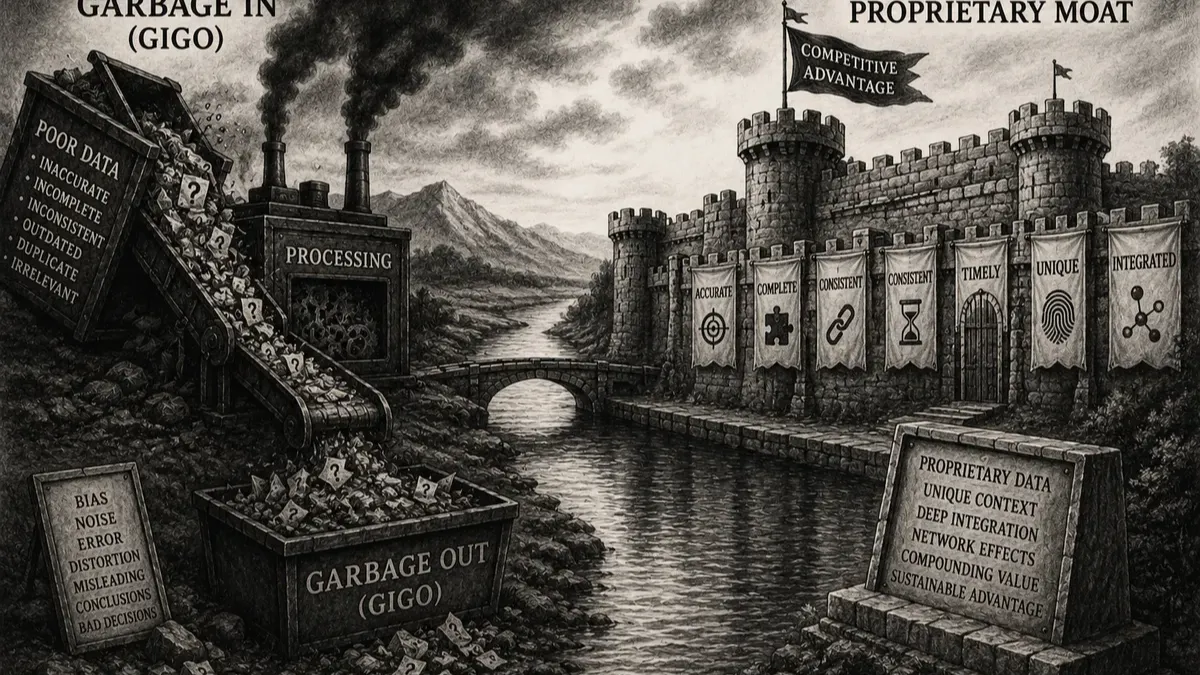
That tension runs through the Data chapter of my book, The Economics of Intelligent Work. The image above presents its two possible outcomes: Garbage In, Garbage Out on one side; Data as a proprietary moat on the other.
AI can make either outcome more consequential.
A system can process incomplete, obsolete, duplicated, or poorly understood Data with extraordinary speed and still produce nonsense. The answer may be articulate. The formatting may be excellent. Neither quality establishes that anyone should act on it.
And people do act. They commit money, Attention, credibility, and time. The cost of bad Data includes the Work undertaken because someone believed it.
Coase’s observation is therefore as much about human behavior as it is about statistics. We bring expectations to the evidence. We prefer some answers to others. AI can help us challenge those preferences. It can also help us construct an exceptionally persuasive defense of them.
Self-deception has acquired a more efficient assistant.
Consider a customer cancellation. A database records the date, account, and lost revenue. All three fields may be accurate. But why did the customer leave? The Conversation preceding the cancellation may contain the answer. The record tells us what happened. The Context may tell us what to do differently.
Data stripped of Context can be technically accurate and economically misleading.
Keeping more of it does not necessarily solve the problem. Organizations must secure, clean, connect, interpret, update, and retrieve what they retain. Litigation makes the distinction painfully clear: keeping another gigabyte may be inexpensive; finding and reviewing the material that matters can be anything but.
Storage was cheap. Retrieval was not.
Yet the other half of the image matters just as much. An organization’s accumulated transactions, customer Conversations, operational histories, failures, and outcomes can become something a competitor cannot readily purchase.
The competitor may acquire the same model. It cannot instantly acquire the same history.
Netflix makes the idea familiar. The customer wants something worth watching. A large catalog creates possibilities, but also a search problem. The chapter examines how accumulated viewing behavior can help reduce the cost of discovery. The visible result is a row of recommendations. The underlying resource is a history of interactions.
Amazon illustrates a similar relationship at the moment of purchase. A useful recommendation helps a customer find something relevant within an enormous catalog. The resulting interaction supplies another signal. Walmart extends the argument into the physical world, where customer demand meets inventory, stores, suppliers, and fulfillment.
In each case, the potential advantage comes from Data connected to a recurring Customer Value problem. Having private Data is insufficient. Proprietary garbage remains garbage.
The useful loop looks something like this:
Data → Work → Reality → Experience → Capture → Better Data → Better Work.
“Better” is doing considerable work in that sentence.
Capture the wrong things, preserve errors, or reward people for confirming yesterday’s assumptions, and the loop can compound misunderstanding. A moat and a garbage dump can both take years to build. Only one is likely to impress the customer.
AI also changes how people reach the information their organizations already possess.
Traditional Business Intelligence has delivered substantial value by organizing structured measures: sales by region, costs by period, inventory by location. Those questions remain useful. So do the governed systems that answer them.
But organizational knowledge also lives in contracts, policies, email, reports, notes, and Conversations. Retrieval-Augmented Generation—RAG—offers a way to retrieve relevant material from selected sources and supply it as Context for an AI response.
A connector helps provide authorized access to a source. Retrieval determines what material is relevant to the question. The model then uses that material in composing its response.
The connector opens the door. It does not certify everything inside.
An obsolete policy remains obsolete when retrieved perfectly. A misleading document remains misleading when summarized elegantly. Business Intelligence and RAG offer different ways to use information; both depend on the quality of the underlying evidence.
And even good Data can be used badly. We can select the convenient sample, discover a pattern in noise, or write a coherent story after the outcome is already known. The harder questions remain human questions: What is missing? What would disconfirm this conclusion? Does the pattern survive outside the sample where we found it?
For an executive, the opportunity begins with a more useful question than “How much Data do we have?”
What do we know, through doing the Work, that a competitor could not simply buy—and how does that knowledge help the Customer?
Then comes the practical question: What can we now do with that knowledge that was previously too expensive, slow, or difficult?
The Data may have been there all along. What changed may be the Transaction Cost of doing something intelligent with it.
Data does not eliminate human judgment. It gives judgment something to work with.
Adapted from Chapter 2, “Data,” of The Economics of Intelligent Work, published by AInomics, LLC. The Kindle edition is available on Amazon.
Quotation note: The chapter traces the opening quotation to Gordon Tullock’s “A Comment on Daniel Klein’s ‘A Plea to Economists Who Favor Liberty,’” Eastern Economic Journal 27, no. 2 (2001), p. 205. Tullock reported hearing Coase say it; he did not identify it as a published sentence by Coase.