
Decisions move through a Decision Space.
A consequential decision begins with several plausible paths. Action creates evidence. Evidence reduces uncertainty. The organization learns which paths remain plausible and which should be pruned.
A Decision in Progress makes movement visible.
Use the controls inside the animation to move forward, backward, pause, and replay. The visual is itself an Operating Artifact: a durable expression of the thinking created in Conversation.
Pruning is not failure.
When Reality invalidates a path, the organization should reject the path while preserving the learning that made the rejection possible.
Pruning in action.
The team advances down one branch, encounters contradictory evidence, returns with preserved learning, and selects a better path. It is not starting over. It is moving forward with better judgment.
Boltzmann’s equation gives us a language for disorder.
Executives already know the experience before the equation: unresolved choices multiply, assumptions drift, ownership blurs, and parallel initiatives create more possible ways for work to proceed. Organizationally, that feels like chaos. Boltzmann gives us a formal language for the underlying intuition that more possible arrangements are associated with greater disorder. This Course uses that intuition—not the physics itself—to illuminate how disciplined Decisions constrain the Decision Space.
Ludwig Boltzmann’s equation provides a useful way to understand entropy: the relationship between disorder and the number of possible arrangements within a system.
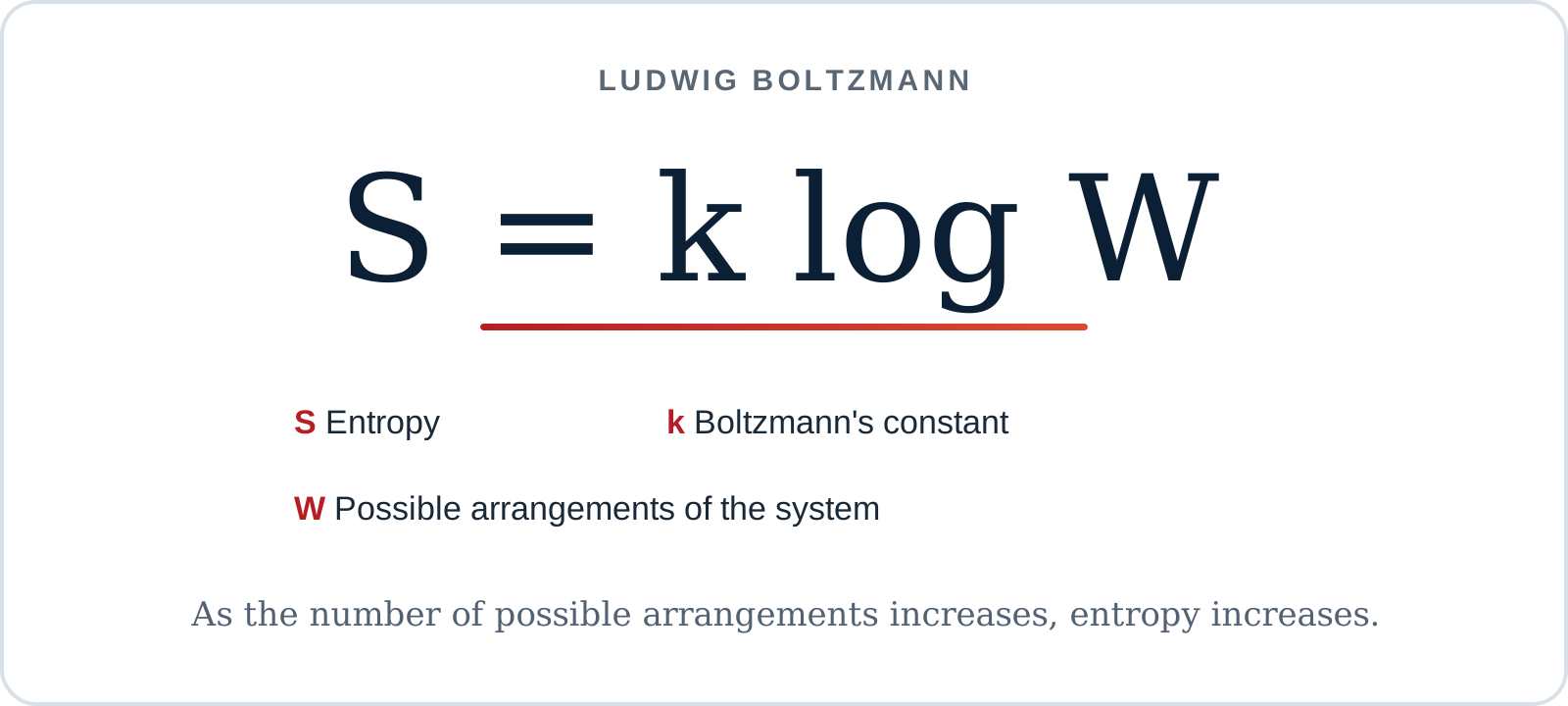
The physics belongs to Boltzmann. The connection to Decisions in Progress, organizational order, and competitive advantage comes from Carlos Leyva’s earlier work in Silicon Stories.
When starting development of any complex system, the number of possible ways that the system could be arranged probably approaches infinity. The W is therefore quite large, and the system is in a state of maximum entropy.
Order is imposed, and entropy is reduced, by reducing the number of Decisions in Progress. By making intelligent, methodical, and relentless decisions, constraints are imposed. As constraints are imposed, the number of possible arrangements is reduced, order increases, and entropy decreases.
Competitive advantage, derived from applied information technologies, will be achieved by increasing the velocity by which the Decision in Progress yields to order. Process Patterns—or the lack of them—affect the Decision in Progress and have a powerful impact on whether the current project will contribute significantly to the end game: competitive advantage.
Course Perspective
This Course extends this insight by viewing every informed decision as an intentional reduction of organizational entropy. Each resolved Decision in Progress prunes the Decision Space, reducing the number of feasible future states until coordinated execution becomes possible.
“HTML as the Lingua Franca.”
AI changed the economics of visualization. HTML provides a shared language for combining prose, graphics, animation, interaction, Shared Vocabulary, citations, Notes, and revision into living Operating Artifacts.
Important Conversations should become visual Operating Artifacts.
Visualization is not decoration. It externalizes mental models, allows assumptions and paths to be inspected, and reduces the cognitive burden of reconstructing complex reasoning from prose alone.
Externalize
Make the mental model visible.
Inspect
Expose assumptions, movement, and contradictions.
Revise
Update the artifact as Reality changes the decision.
Where is your organization navigating a Decision Space?
Review, refine, or add to the Notes you captured throughout this Module.
Identify one path that Reality may already have weakened. What learning must be preserved before the path is pruned?
Learning reduces the Decision Space.
Make the Decision in Progress visible. Move. Encounter Reality. Prune implausible paths. Preserve learning. Choose again. Continue until the solution is Good Enough to execute.